
In every boardroom I sit in, the same question comes up in different forms: where is the next durable source of growth that isn’t already over‑financialized, over‑extracted, or over‑regulated?
Most leaders are looking in the wrong places.
One of the largest, least structured, and most undervalued asset classes in the world is already hiding in plain sight: cultural heritage.
Not as nostalgia. As infrastructure for global industries.
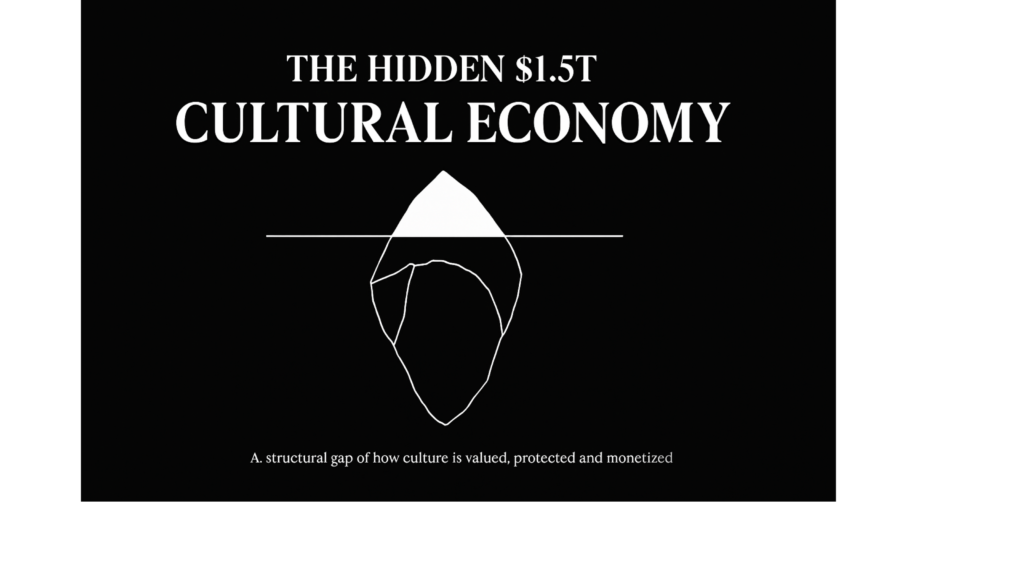
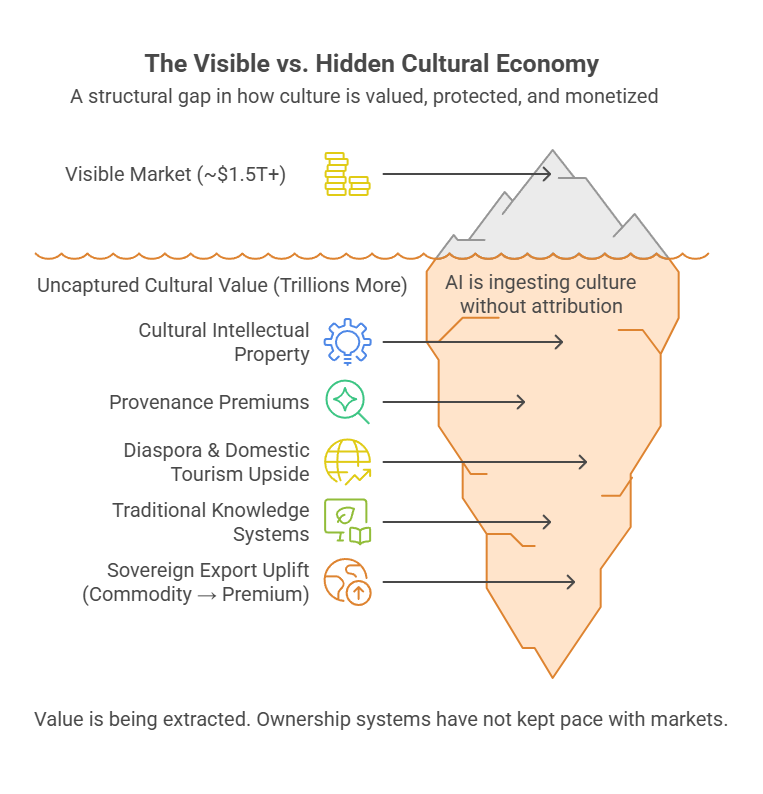
Luxury alone is a ~$360–$400B market. Handicrafts and artisan goods add another ~$700–$900B. Cultural tourism pushes the broader ecosystem well past $1.5T annually. Yet the underlying asset—cultural knowledge—remains largely undocumented, unprotected, and economically invisible.
Which means two things are true at once:
- A trillion‑dollar market already exists
- A significant additional layer of value remains unrecognized, unpriced, and unclaimed
That gap is the opportunity.
Culture Is Entering the Digital System—Faster Than Governance
For decades, organizations such as UNESCO have led efforts to safeguard Intangible Cultural Heritage (ICH)—living traditions, practices, and knowledge systems passed down through generations.
That work is now intersecting with digital infrastructure and artificial intelligence at scale.
Cultural knowledge is being captured, modeled, and embedded into global systems—often unevenly. The result is not just preservation challenges, but:
- systemic cultural bias in AI outputs
- economic extraction without attribution or participation
From the EU’s AI regulatory direction to national strategies across the Global South, there is growing recognition that cultural representation in digital systems is a matter of sovereignty, not just heritage.
But recognition alone does not create economic participation.
Where the Immediate Economic Opportunity Already Exists
This is not a future market. It is a current one—with clear, near‑term entry points.
1. Craft, Fashion, and Luxury Supply Chains
Current market: ~$1.1T combined
Hidden layer: provenance premiums, IP protection, and supply chain differentiation
Global fashion and luxury depend heavily on traditional techniques, motifs, and artisanal processes.
- Heritage craftsmanship drives pricing power but is rarely verified
- Copying is widespread across both fast fashion and premium segments
- Even a 5–10% provenance premium across segments represents tens of billions in upside
2. Food, Agriculture, and Culinary Systems
Current market: multi‑trillion global food economy
Hidden layer: origin-linked value, protected techniques, climate-resilient knowledge
- Region-linked products already command premiums (e.g., GI products)
- Traditional agricultural knowledge contributes to climate resilience and biodiversity
- Formal recognition can significantly increase sovereign export value
This is where sovereign upside is immediate—countries that formalize cultural food systems can move from commodity pricing to premium exports.
3. Cultural Tourism and Experience Economies
Current trajectory: $16.5T by 2035 (WTTC)
Domestic: $7.7T | International: $2.9T
The largest, most overlooked opportunity is not international tourism—it is:
- domestic tourism
- diaspora tourism
These segments are:
- less volatile
- more culturally engaged
- more likely to spend on authentic experiences
Yet most countries lack structured systems to map, verify, and activate their cultural assets. That is lost revenue at the national scale.
4. Health, Wellness, and Traditional Knowledge Systems
Current market: $5T+ global wellness economy
Hidden layer: traditional medicine, preventative systems, cultural practices
- Traditional knowledge is routinely commercialized without attribution
- Documenting it as prior art prevents external patent capture
- Formalization enables sovereign participation in global wellness markets
5. Education, Climate, and Energy Knowledge Systems
Current markets: policy-driven, multi-trillion-dollar transition sectors
Hidden layer: indigenous and traditional knowledge systems
- Climate adaptation increasingly depends on local ecological knowledge
- Traditional building methods inform low-energy design
- Cultural education systems underpin identity and social resilience
These are not “soft sectors.” They are central to national strategy.
What Is Cultural Intellectual Property?
If this market is to function, one concept needs to be made practical: cultural intellectual property.
Cultural IP includes:
- traditional craft techniques and design systems
- agricultural and ecological knowledge
- culinary practices tied to geography
- traditional medicine and wellness systems
- performance traditions and cultural expressions
Some protection exists today:
- Geographical Indications (GI) (e.g., Champagne, Darjeeling tea)
- Copyrights and design protections (limited and often inaccessible)
But one of the most underused and powerful tools is prior art.
By documenting that knowledge already exists within a community, prior art:
- blocks external patent claims
- establishes origin
- creates a basis for challenging misuse
For most artisans and communities, this level of protection is far more realistic than full legal enforcement—and often sufficient to assert economic rights.
Today, most cultural knowledge is not even documented at this basic level.
The Real Prize for Sovereigns: Export Power
This is where the conversation shifts from culture to economics.
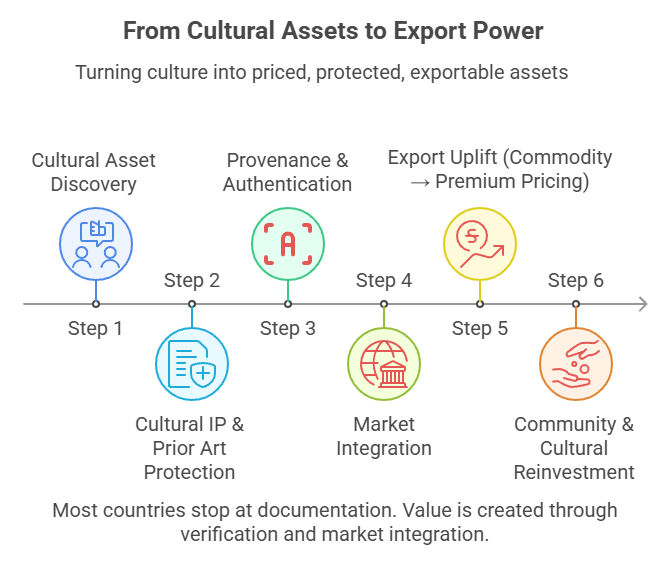
Countries that identify, document, and protect cultural knowledge can:
- convert informal heritage into recognized national IP assets
- increase export pricing through provenance and authenticity
- protect against foreign appropriation of traditional knowledge
- build differentiated tourism economies
- strengthen cultural diplomacy and soft power
In practical terms, this means moving from:
commodity exports → heritage-based premium exports
That transition alone can materially shift trade balances in certain sectors.
This Will Not Be Coordinated—And Doesn’t Need to Be
There is a tendency to frame this as a cross-sector collaboration problem.
In reality, each group has its own entry point:
- Governments: define and protect cultural IP, expand GI frameworks, invest in national registries
- Corporations: integrate provenance into supply chains, capture premiums, de-risk sourcing
- Philanthropy & development finance: fund documentation, data infrastructure, and inclusion
Alignment is useful. It is not required.
Progress will come from parallel action, not perfect coordination.
The Bottom Layer: Who Gets Paid
If this market is unlocked, capital will concentrate quickly at the top.
That is predictable.
The real question is whether systems exist so that value can reach the source:
- the artisan
- the community
- the culture that created the knowledge
That does not require perfect redistribution.
Even a small, structured flow of value—enabled by attribution, documentation, and basic IP protection—can:
- materially increase artisan incomes
- reinforce cultural identity
- sustain traditions currently at risk of disappearing
Without those mechanisms, formalizing this market will accelerate extraction.
With them, it becomes one of the most inclusive economic expansions available today.
A Market Hiding in Plain Sight
The global economy already runs on culture. It just doesn’t recognize it.
For those who move early—sovereigns, corporations, capital—the upside is not just access to a $1.5 trillion-plus market.
It is the ability to define how that market works.
And that, more than anything, is where the real value lies.
Charles Kao
Founder of Artisanal Collective, working on cultural heritage, provenance, and the economic systems that support it.