We are not starting from zero.
Across the world, governments, UNESCO, UN agencies, academia, and policy bodies are actively shaping the future of artificial intelligence—developing governance frameworks, ethical guidelines, and regulatory structures.
At the same time, NGOs, CSR programs, and development agencies continue to work directly with communities—supporting artisans, rural economies, and cultural preservation.
And increasingly, AI companies are building systems for:
- cultural knowledge aggregation
- market access
- empowerment tools
- digital identity and storytelling
This is not a fragmented landscape due to lack of effort.
It is fragmented because these efforts are not operating within a shared framework that allows them to work together.
The Challenge Is Not Control—It Is Coordination
No single entity can—or should—control how cultural knowledge is captured, used, owned, or monetized.
Governments cannot dictate how AI systems evolve globally.
AI companies cannot be expected to independently solve cultural representation, governance, and economic inclusion.
NGOs cannot build scalable systems on their own.
The issue is not authority.
It is the absence of a collaboration framework that allows each to contribute within their strengths.
A Framework That Allows Participation
A viable model is not centralized. It is participatory.
It enables:
- Governments and sovereign institutions to define language, education structures, cultural ownership, and national-level governance
- Governments, UNESCO, UN bodies, and academia to contribute global standards, research, and ethical guardrails
- AI and technology companies to build systems that can interoperate rather than operate in isolation
- NGOs and community programs to bring trust, implementation, and direct engagement with communities
Rather than forcing alignment, the framework allows parallel participation under shared principles.
Where Governance Actually Matters
There is a growing focus on AI governance globally.
But governance is most effective when it is embedded into systems, not layered on after the fact.
A collaborative framework allows governance to exist at multiple levels:
- Global principles informed by institutions such as UNESCO, WIPO, and international bodies
- Regional alignment reflecting cultural and economic contexts
- National sovereignty over language, education, and cultural intellectual property
This is not about imposing rules.
It is about ensuring that systems being built today can operate within shared guardrails while respecting local ownership.
The Human Layer Behind AI
From a technical perspective, acquiring cultural knowledge for AI systems is increasingly feasible.
The real challenge lies elsewhere:
- structuring knowledge
- validating accuracy
- maintaining quality over time
This cannot be solved by technology alone.
It requires human systems.
There is already a vast, underutilized base of contributors:
- diaspora communities
- cultural practitioners
- academic institutions
- volunteer networks aligned around culture
When organized effectively, these groups can support:
- quality assurance
- language and dialect accuracy
- contextual integrity of cultural knowledge
Linking to Real Economies
This framework is not only about knowledge.
It connects directly to economic participation.
Consider sectors already receiving large-scale investment:
- rural community tourism
- cultural and creative industries
- artisan and SME development programs
Billions are spent to:
- develop tourism infrastructure
- market cultural destinations
- support community-based programs
Yet the linkage between these efforts and consistent, scalable economic participation at the community level remains limited.
A shared framework enables:
- direct connection between cultural output and markets
- traceable economic activity
- integration of storytelling, provenance, and commerce
Expanding Participation Beyond Large Capital
The opportunity is not limited to large institutions.
There is significant, underutilized participation from:
- SMEs
- diaspora investors
- culturally aligned individuals
When transactions are traceable and value flows are transparent, it becomes possible to:
- support community-based enterprises
- enable smaller-scale investment participation
- create pathways for both return and impact
What This Enables
When existing efforts are connected through a collaboration framework, the outcome is not incremental.
It is systemic.
- cultural knowledge is documented and protected
- AI systems become more representative and accountable
- communities participate economically, not just culturally
- sovereigns retain ownership while engaging globally
The Path Forward
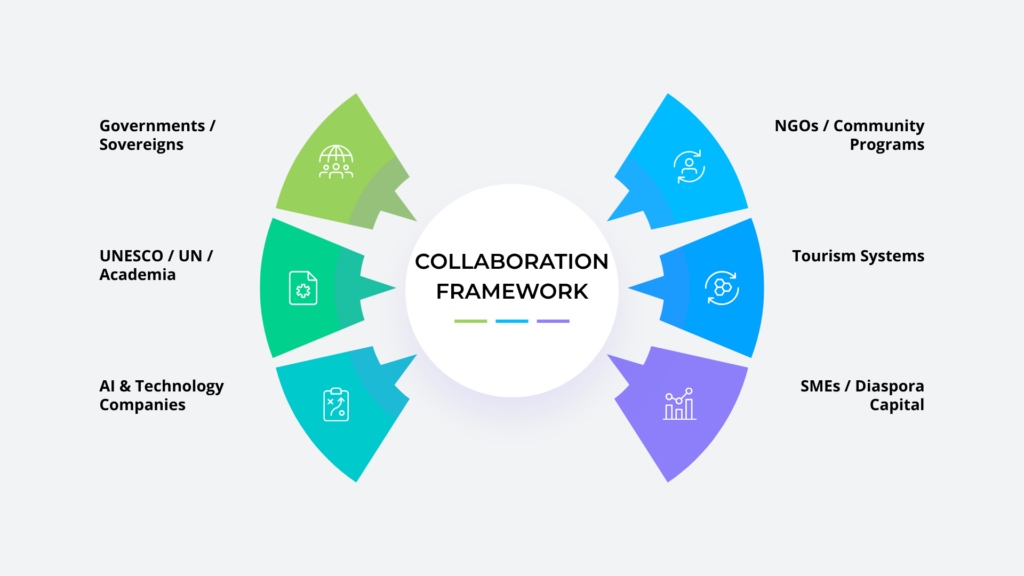
Figure: A collaboration framework enables governments, institutions, technology, and markets to operate in parallel—connecting cultural knowledge to economic participation.
The cultural economy does not need to be built from scratch.
The pieces already exist:
- policy and governance
- community programs
- technology systems
- global and local knowledge networks
What is required is a way for them to operate together without losing their independence.
This naturally raises two questions:
Who provides the framework?
Who manages it?
The answer is not a single institution.
Frameworks can emerge from multiple credible sources—some already exist in adjacent forms, and others will continue to develop. The objective is not exclusivity, but interoperability.
Management, similarly, does not require a new centralized body.
There are already organizations—at global, regional, and national levels—whose core function is to design, manage, and execute programs. These institutions can take on roles within such a framework:
- some acting as coordinators
- others as implementers
- others as custodians of governance and standards
Participation does not need to be fixed.
Different organizations can take on responsibilities over time, allowing for adaptability, regional relevance, and broader inclusion.
The Role of Global Talent
An often overlooked asset in this equation is human capital.
Across the world, there are thousands of highly qualified individuals—across disciplines including technology, culture, policy, education, and development—who are willing to contribute their time.
- diaspora professionals
- academics and researchers
- experienced practitioners
- culturally aligned volunteers
These individuals can support governance, advisory functions, and quality assurance systems.
In many cases, they are willing to participate not as passive supporters, but as active contributors to systems that align with both cultural and economic outcomes.
The hidden cultural economy is not waiting to be created.
It is waiting to be connected.
Charles Kao
Founder of Artisanal Collective, working on cultural heritage, provenance, and the economic systems that support i
Pingback: Artisanal Collective Launches AEMS Living Heritage Lab to Support Artisan Empowerment, Cultural, and Market Access | lifestyle.thepointnews.com