Cultural Sovereignty in the Digital Age
As societies become increasingly digital, control over cultural knowledge is emerging as an important dimension of sovereignty.
For centuries, cultural knowledge has been transmitted through communities, artisans, and oral traditions. In the digital era, however, knowledge increasingly exists in data systems that shape global markets, education, and artificial intelligence.
Without systematic documentation and governance, much of the world’s cultural knowledge risks becoming:
• digitally invisible
• misrepresented in global knowledge systems
• commercialized without recognition or benefit to the communities that created it
For many countries—particularly across the Global South—this represents a growing concern.
Cultural traditions such as craft techniques, agricultural knowledge, artistic expressions, and community heritage practices represent forms of cultural intellectual property that contribute to national identity and economic development.
As artificial intelligence systems increasingly shape how knowledge is accessed and interpreted worldwide, ensuring the fair representation of cultural traditions has become a matter of cultural sovereignty.
The Cultural Knowledge Trust provides infrastructure that enables nations and communities to:
• document cultural knowledge systems
• protect traditional knowledge from misappropriation
• strengthen cultural industries
• ensure that digital knowledge systems reflect the diversity of global cultures
By combining cultural stewardship with modern digital infrastructure, the Trust supports a future in which cultural heritage remains visible, protected, and economically meaningful in the digital era.
Emerging Challenges
Cultural Bias in AI
Digital documentation of Intangible Cultural Heritage (ICH) remains extremely limited and unevenly distributed.
ICH includes:
• traditional practices
• knowledge systems
• cultural expressions
• rituals and performance traditions
• associated objects, tools, and cultural spaces
Much of the cultural data currently available online has been collected primarily from Western sources. As a result, large language models and other AI systems often lack adequate representation of the traditions of much of the world.
With billions of AI interactions occurring every month—and approximately 30% of users coming from the Global South—this imbalance risks reinforcing cultural bias in digital knowledge systems.
Expanding global documentation of cultural knowledge is therefore critical not only for heritage preservation but also for ensuring fair representation in the digital knowledge systems shaping the future.
The Heritage Knowledge Gap
Across the world, traditional craftsmanship and cultural knowledge form the foundation of cultural identity, community resilience, and economic opportunity. Yet much of this knowledge remains undocumented, economically undervalued, and vulnerable to disappearance due to urbanization, economic displacement, and generational change.
At the same time, global markets increasingly depend on heritage traditions.
Two major sectors illustrate the scale of this ecosystem:
• Global Personal Luxury Goods: approximately $360B–$398B annually
• Global Handicrafts and Artisan Goods: approximately $740B–$900B annually
Together, these sectors represent a heritage-craftsmanship economy exceeding $700B annually and more than $1.5 trillion when cultural tourism and heritage experiences are included.
Despite this scale, there is currently no global infrastructure to document, verify, and responsibly activate cultural knowledge.
The Cultural Knowledge Trust
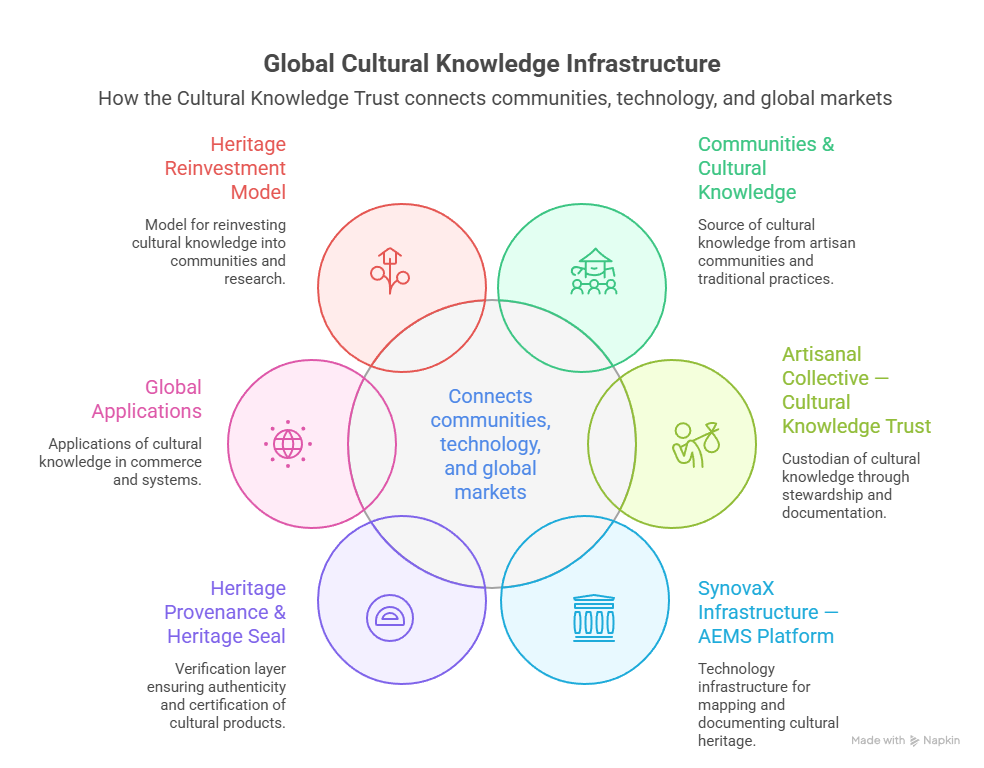
The Artisanal Collective Cultural Knowledge Trust establishes a global infrastructure to document, verify, and activate cultural knowledge, ensuring that communities benefit from the value created.
The Trust connects cultural stewardship with modern digital infrastructure, enabling cultural heritage to participate responsibly in the global economy and digital knowledge systems.
Ecosystem Overview
Heritage Reinvestment Model
- Community Heritage Fund (50%)
- Global Heritage Research – supporting initiatives with organizations such as UNESCO (15%)
- Infrastructure Development (35%)
The Three Pillars of the Cultural Knowledge Trust
1. Cultural Knowledge Documentation
The first pillar is the large-scale documentation of cultural knowledge through the Artisanal Excellence Mapping System (AEMS).
AEMS provides a multilingual platform designed to document a wide range of cultural traditions, including:
• traditional crafts and artisan techniques
• agricultural and ecological knowledge
• design systems and materials
• performance traditions such as music and dance
• community heritage practices
By systematically documenting these traditions, AEMS helps preserve cultural knowledge while creating structured data that can support research, education, cultural industries, and digital knowledge systems.
2. Cultural Provenance Verification
The second pillar is the ability to verify when products, services, or experiences rely on documented cultural knowledge.
The Heritage Provenance system enables brands, institutions, and organizations to connect products and experiences to verified cultural traditions.
The Heritage Seal provides a visible certification mark that signals authenticity to consumers and partners.
Together, these systems establish a new category of infrastructure: Cultural Provenance — the ability to verify the cultural origins of knowledge, craftsmanship, and heritage practices.
3. Responsible Cultural Commerce
The third pillar focuses on enabling markets to engage responsibly with cultural heritage.
Programs supporting this pillar include:
• WH Collection retail brands
• Cultural and Heritage Mapping for tourism
• Family Heritage Reports for diaspora communities
• Academic and museum partnerships
• Sovereign Cultural IP programs
These initiatives connect cultural knowledge with global markets while ensuring that communities and cultural institutions benefit from the value created.
Core Infrastructure
AEMS — Artisanal Excellence Mapping System
A multilingual platform designed to document cultural knowledge across domains such as crafts, agriculture, design systems, performance traditions, and community heritage practices.
AEMS provides structured metadata and documentation systems that enable cultural knowledge to be preserved, organized, and responsibly activated.
Heritage Provenance
A verification system confirming when products or practices rely on documented cultural knowledge.
Heritage Provenance enables brands, institutions, and organizations to link products and experiences to verified cultural traditions.
Heritage Seal
A certification mark allowing brands and consumers to identify products and services connected to verified cultural heritage.
The Heritage Seal translates cultural documentation into a visible signal of authenticity and trust.
Cultural Knowledge Powering Economic Opportunity
The Cultural Knowledge Trust supports a range of initiatives designed to responsibly activate cultural heritage:
WH Collection Retail Brands
Curated global brands showcasing creative offerings of artisans who might otherwise not be recognized:
• Artisanal Collection™
• Artisan Lorvée™
Cultural & Heritage Mapping
Infrastructure for tourism organizations to develop heritage trails, cultural journeys, and destination storytelling.
Family Heritage Reports
Personalized heritage reports designed to reconnect diaspora communities with their cultural traditions.
Academic and Museum Partnerships
Access to structured cultural knowledge datasets supporting exhibitions, research, and provenance verification.
Sovereign Cultural IP Programs
Partnerships with governments to document and protect national cultural knowledge assets.
Governance Structure
The ecosystem operates through three complementary entities, which together coordinate a global coalition of program partners.
Artisanal Collective
A nonprofit cultural stewardship organization and governance of the Cultural Knowledge Trust.
SynovaX LLC
Technology infrastructure provider responsible for the development and operation of the AEMS platform and verification systems
WH Collection LLC
Commercial operator responsible for market partnerships, certification programs, and heritage commerce initiatives.
Heritage Reinvestment Model
A core principle of the Cultural Knowledge Trust is that economic value generated from cultural knowledge must flow back to the communities that created it.
Commercial programs operating within the ecosystem contribute a portion of their operating income to the Cultural Knowledge Trust.
Funds are allocated through three primary channels:
Community Heritage Fund – 50%
Direct grants to nonprofit organizations operating in the communities where cultural knowledge originates. Programs support:
• artisan training
• cultural education
• heritage preservation
• community economic development
Global Heritage Research – 15%
Support for research, documentation, and heritage safeguarding initiatives, including collaboration with organizations focused on Intangible Cultural Heritage.
Cultural Knowledge Infrastructure – 35%
Investment in the ongoing development and protection of the cultural knowledge platform, including:
• digital infrastructure development
• geographic indication documentation
• intellectual property defense
• heritage knowledge documentation programs
This reinvestment model ensures that cultural knowledge is not simply commercialized but sustainably stewarded for future generations.
Expected Impact
The Cultural Knowledge Trust establishes a new category of global infrastructure designed to:
• protect traditional knowledge
• support artisan livelihoods
• enable responsible cultural commerce
• strengthen cultural tourism
• reduce cultural bias in digital knowledge systems
By connecting cultural stewardship with modern infrastructure, the Trust enables global markets and digital technologies to engage responsibly with the value of cultural heritage.
Why Now?
Several global trends are converging to create an urgent need for infrastructure capable of documenting, verifying, and responsibly activating cultural knowledge.
1. The Global Luxury Market Is Shifting Toward Provenance
Luxury consumers increasingly prioritize authenticity, craftsmanship, and traceability.
Industry research indicates that a majority of luxury consumers now prioritize sustainable and handmade goods, and major brands increasingly rely on heritage craftsmanship as a differentiator.
While traceability systems exist for materials such as diamonds, wool, and leather, no global system exists to verify cultural provenance.
2. Cultural Tourism Is Rapidly Expanding
Global tourism spending exceeds $1.5 trillion annually, with cultural tourism among its fastest-growing segments.
Governments and tourism organizations are increasingly seeking ways to develop heritage trails, cultural storytelling initiatives, and community-based tourism experiences.
However, most destinations lack structured cultural knowledge systems that can support authentic cultural engagement.
3. Cultural Knowledge Is Disappearing
Across many regions, traditional knowledge systems are being lost due to urban migration, generational shifts, economic displacement, and declining incentives for traditional crafts.
Without systematic documentation, much of this knowledge risks disappearing within a generation.
4. Cultural Bias in Digital Knowledge Systems
AI systems are becoming the primary interface through which people access knowledge. However, the cultural datasets used to train these systems are heavily skewed toward Western sources.
This lack of representation risks reinforcing systemic cultural bias, particularly for users in the Global South.
5. Hidden Cultural Intellectual Property Is Being Extracted
Cultural knowledge frequently informs global industries such as fashion, textiles, traditional medicine, agriculture, and artistic design.
Yet communities often lack mechanisms to document, protect, or license their cultural intellectual property.
As a result, cultural traditions are frequently commercialized without attribution or economic participation by the communities that created them.
A Unique Moment
The convergence of these trends creates a unique opportunity to build infrastructure that can:
• document cultural knowledge
• verify heritage authenticity
• support artisan economies
• strengthen cultural tourism
• reduce cultural bias in digital knowledge systems
• protect cultural intellectual property
The Cultural Knowledge Trust aims to establish this infrastructure and ensure that cultural heritage can participate responsibly in the global and digital economy.